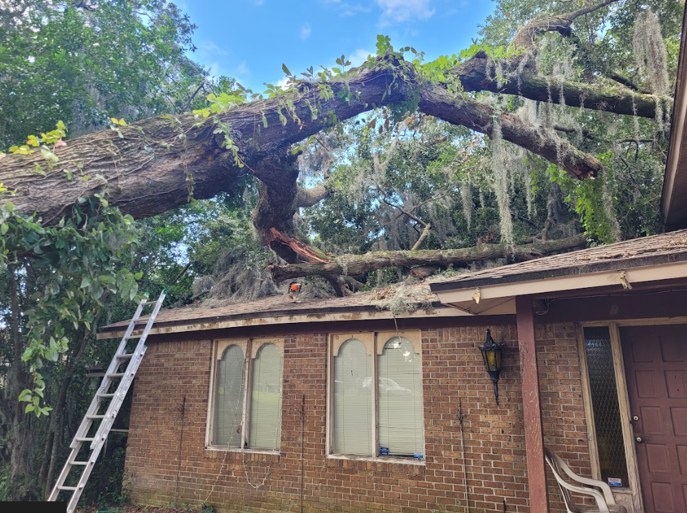
Whose Fault Is It When a Tree Falls in Florida?
People call it the “fallen tree act.” In reality, Florida has no single statute that decides who pays — it comes down to negligence, notice, and whether the tree was a known hazard. Here’s the plain-English breakdown for Duval County homeowners.
The Four Things That Actually Decide It
General No-Fault Rule
When a healthy tree falls in a storm, the owner of the property it lands on generally handles it through their own insurance — an "Act of God."
The Dangerous-Tree Exception
If the tree was dead, diseased, or an obvious hazard the owner ignored, liability can shift to that owner under Florida negligence law.
Notice Is Everything
A certified letter with photos of the decay creates "actual notice" — the single most powerful protection if a neighbor's tree later falls.
Your Self-Help Right
You may trim encroaching branches and roots up to your property line at your own expense, so long as you don't kill the tree.
Facts, Not Fiction
Who’s Liable When a Tree Falls in Florida?
Florida follows a general “no-fault” rule for trees — but there’s a major exception. Liability for a dangerous, dead, or diseased tree falls on the owner of the tree (the lot where it was rooted), not automatically on whoever it lands on.
Dead / Diseased / Hazardous
The tree owner (where it was rooted) is responsible for damage & removal.
Negligence / Premises Liability
Live / Sound / Healthy
The lot owner it fell on (the impacted neighbor) generally handles it.
“Act of God” / Massachusetts Rule
How Responsibility Is Determined
Actual or constructive notice: The tree owner knew — or reasonably should have known — the tree was a hazard: visible decay, dead limbs, a severe lean, or an arborist previously calling it unstable.
Failure to exercise reasonable care: Owners have a legal duty to maintain safe premises. Ignoring an obvious hazard until a storm finally blows it over does not excuse the pre-existing neglect.
Insurance & subrogation: The impacted owner’s insurer typically pays for repairs, then uses subrogation to recover from the dangerous-tree owner’s insurer. If the owner knowingly ignored the hazard, their own carrier may even deny liability coverage.
Protecting Yourself From a Neighbor’s Dangerous Tree
Send Written Notice
Photograph the decay and send a certified letter asking your neighbor to address it. This creates irrefutable “actual notice” if the tree later collapses.
Exercise “Self-Help”
You may cut encroaching roots or overhanging branches up to your property line at your own expense — as long as the trimming doesn’t kill the tree.
As Florida attorneys explain, liability usually follows negligence — not just where the tree happens to land. See Morgan & Morgan and Farah & Farah.
Informational only — not legal advice. For your specific situation, consult a licensed Florida attorney.
Storm Damage vs. a Known Hazard
The single biggest factor in a Florida tree claim is whether the tree was healthy or a foreseeable hazard. That one distinction usually decides whose insurance pays.
Healthy Tree, Storm Fell It
Treated as an “Act of God.” The owner of the property it lands on generally files with their own homeowner’s policy — regardless of which lot the tree was rooted on.
Dead / Diseased / Ignored
If the owner had notice the tree was a hazard and did nothing, liability can shift to them. The impacted owner’s insurer may pay first, then subrogate against the negligent owner’s carrier.
Fallen Tree Liability FAQs
Is there a "Florida Fallen Tree Act" or a Statute 724 that decides who pays?
There is no single Florida statute — and no "Statute 724" — that governs who pays when a tree falls. Florida tree-damage liability is decided under long-standing common law: a general "no-fault" rule that whoever the tree lands on handles it, with a major negligence exception when the tree was dead, diseased, or an obvious hazard the owner knew about and failed to address.
A healthy tree fell on my house during a storm — who is responsible?
When a live, sound, healthy tree is blown over by a storm, Florida treats it as an "Act of God." Under the general no-fault rule, the owner of the property it lands on typically files with their own homeowner's insurance — even if the tree was rooted on a neighbor's lot.
A dead or diseased tree fell from my neighbor's yard — can they be held liable?
Potentially, yes. If the tree was visibly dead, diseased, decayed, or dangerously leaning, and the owner had actual or constructive notice of the hazard yet failed to take reasonable care, they can be held liable for the resulting damage under a negligence / premises-liability theory.
Whose insurance pays first?
In most cases the impacted property owner's insurer pays for the repairs first. If the tree was a known hazard, that insurer may then pursue subrogation to recover its costs from the negligent tree owner's insurer. If an owner knowingly ignored a dangerous tree, their own carrier may even dispute coverage.
How do I create "notice" that a neighbor's tree is dangerous?
Photograph the decay, dead limbs, or severe lean, then send your neighbor a certified letter asking them to address it. A certified letter creates irrefutable "actual notice" — so if the tree later collapses, the owner cannot claim they had no idea it was a hazard.
Can I trim a neighbor's branches or roots that cross onto my property?
Florida recognizes a "self-help" right: you may trim encroaching branches and roots back to your property line at your own expense — as long as the trimming does not kill or destroy the tree. It does not, by itself, shift liability for the whole tree onto you.
What if the tree belongs to the city, county, or my HOA?
When a hazardous tree is on municipal, county, or HOA-controlled land, responsibility follows ownership and control of that land. Report the hazard in writing to the responsible entity to establish notice, and keep a copy — the same negligence principles apply to public and association owners.
Does the tree have to be fully dead for the owner to be liable?
No. Liability turns on whether the tree was an obvious, foreseeable hazard — significant decay, large dead limbs, root rot, or a severe lean can all establish that a reasonable owner should have known it was dangerous, even if the tree was not completely dead.
Dangerous Tree Threatening Your Home?
Don’t wait for it to fall. We remove hazardous trees and document everything your insurer needs. Call for fast service and a free estimate.
Informational only — not legal advice. For your specific situation, consult a licensed Florida attorney.