
For Homeowners · P1Mitigators™
How Your Insurance Claim Gets Paid
Most claims are not one check.
They pay in stages, and the checks come to you.
Here is the whole process, start to finish.
Start Here
Replacement Cost Value / Actual Cash Value
Replacement Cost Value (RCV) is the total payout per trade, per line item.
It should include any Overhead & Profit (O&P) if that pertains to your claim.
Actual Cash Value (ACV) is the RCV minus depreciation.
The depreciation held back is paid once the work is proven complete.
Defined by:
Florida Statute §627.7011 — replacement cost and actual cash value on homeowner policies.
NAIC Glossary of Insurance Terms — National Association of Insurance Commissioners.
Claim Summary
Example numbers
| Line items (all trades) | $18,000.00 |
| Overhead & Profit (if it applies) | $3,600.00 |
| Replacement Cost Value (RCV) | $21,600.00 |
| Less recoverable depreciation | ($4,200.00) |
| Actual Cash Value (ACV) | $17,400.00 |
| Less your deductible | ($2,500.00) |
| Net ACV check (Check #1) | $14,900.00 |
Why It Looks Like Two Separate Payouts
You will likely receive more than one check.
They are all pieces of the same RCV total.
Check #1 (ACV): the RCV minus depreciation, minus your deductible.
Check #2 (Holdback): the recoverable depreciation the carrier keeps until the work is done.
Once the final invoice proves the work is complete, the carrier releases Check #2.
RCV $21,600 (example)
Your deductible: $2,500 (paid by you)
Check #1 ACV: $14,900
Check #2 depreciation holdback: $4,200
The bottom line for your contractor
They are owed the full RCV minus your deductible.
The O&P line only explains how the carrier reached the RCV.
It is not an extra bonus paid on top of the RCV.
The 3 Checks at a Glance
Check #1
ACV
Actual Cash Value
When: After the carrier approves the estimate
Goes to: You, then the contractor
Used for: Starts the job + your deductible
Check #2
RD
Recoverable Depreciation
When: After work is proven complete
Goes to: You, then the contractor
Used for: Paid to the contractor who finished
Check #3
SUPP
Supplement
When: After hidden damage is documented
Goes to: You, then the contractor
Used for: Paid to the contractor for the added work
Your deductible is paid by you at the start.
Florida law (§817.234) does not let a contractor waive or rebate it.
…More: how the deductible really gets paidHide
If your first contractor’s bill is less than your total deductible, you only pay that bill, not your entire deductible.
Get a receipt proving you paid it.
Do the same with the next contractor, until you reach the most you should ever pay: your deductible.
This is how it works, no matter what an adjuster, contractor or insurance claims (CAT) staffer tells you.
People tell homeowners different things to make their own paperwork trail easier, and that information is often wrong.
Real example · 2024 hurricane tree removal
We helped our tree removal client collect an $11,400 deductible.
The State Farm CAT adjuster was livid. His exact words:
“In 20 years doing claims I have never seen a tree company collect a deductible this large and collect it up front. Now I have to go back and change my paperwork to reflect this, which will take hours!”
Field adjusters are very busy.
They are paid to process claims and move on.
Your claim is one of the 200 they will run that month, whether you see it or not.
The Claim Payout Process — 10 Steps
- 1
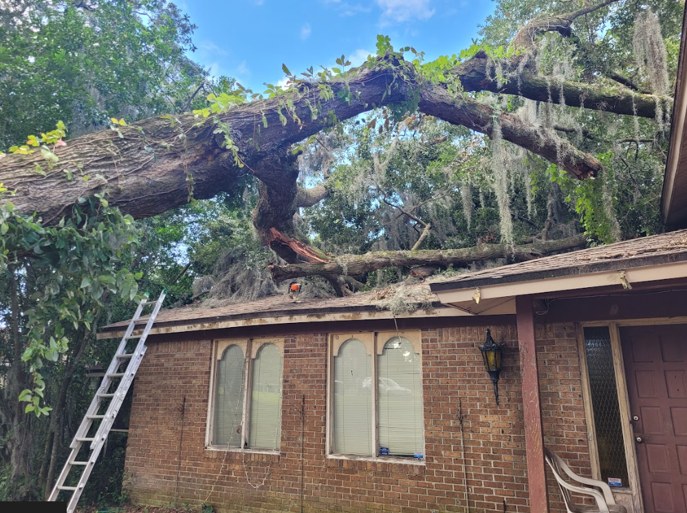
The Loss Happens
Storm, fallen tree, water leak or accident.
Take photos and video right away.
Stop further damage if it is safe (tarp, shut off water).
- 2
Call the Carrier’s 800 Claims Line
Call the claims number on your policy or carrier app.
Not the local agent’s office.
Write down your claim number. Every check and form uses it.

- 3
Pick a Contractor Who Works Insurance Claims
Choose a team that knows the claim payout process and will accept it.
Ask: “Do you work from the carrier’s estimate, ACV checks and supplements?”
If they say no, keep looking.

- 4
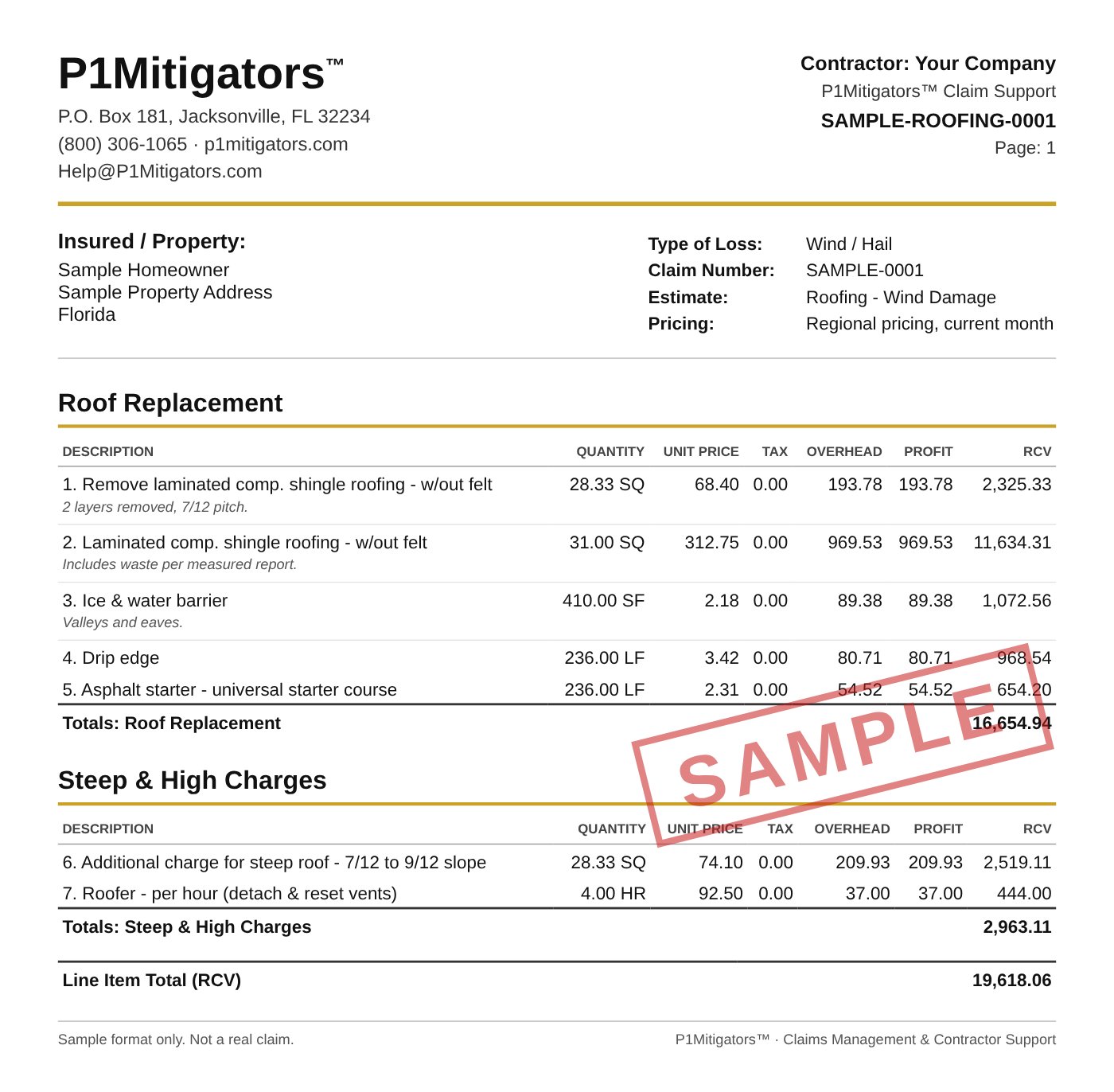
Get Every Type of Damage Estimated
Roof, interior, water, tree, fence, concrete — each trade is estimated.
Several trades? A project manager like P1Mitigators™ keeps them in one file.
Missed damage now usually means missed money later.
- 5
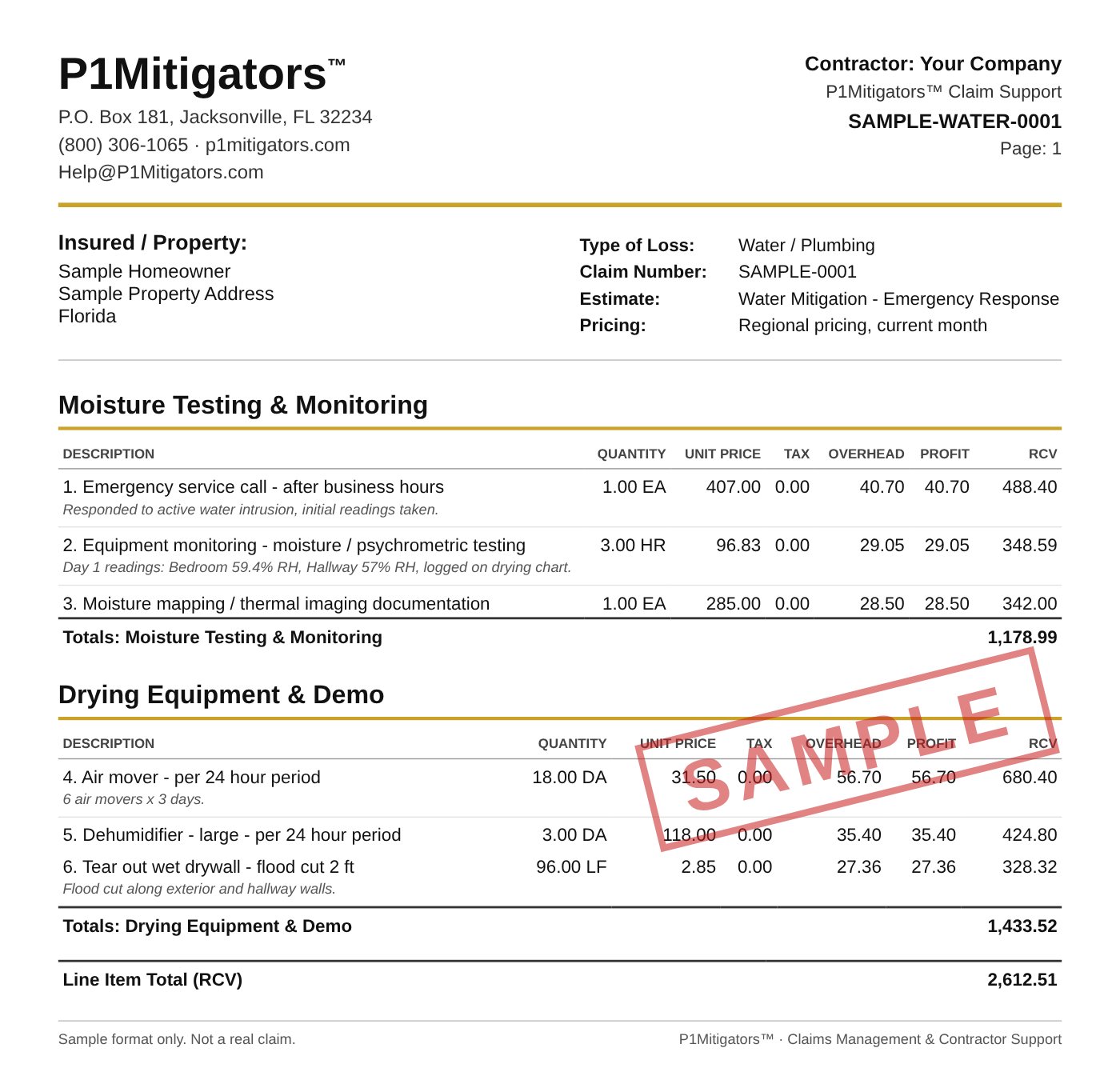
Request for Repairs Is Submitted
The full repair estimate, photos and reports go to the carrier.
Everything is tied to your claim number.
- 6
Carrier Sends Its Own Estimate
The two estimates are compared line by line.
Missing items are documented and supplemented.
Questions about your policy go to your carrier.

- 7
Check #1 — Actual Cash Value (ACV)
The first check comes to YOU.
You pay the first contractor (or first set of contractors) to start work.
You also pay your deductible. Florida law does not let a contractor waive or rebate it.
Your Insurance Carrier
Example
Check #1 · Actual Cash Value (ACV)
Pay to the order of
You (the homeowner) + mortgage company if listed
Memo: ACV less deductible · Claim #
$14,900.00
You deposit it, then pay the contractor who did the work.
- 8
Work Is Completed and Proven
Contractors send completion photos, invoices and permits/final inspections.
Proof goes to you and to the carrier.

- 9
Check #2 — Recoverable Depreciation (RD)
Released after the work is proven complete.
It comes to YOU, then you pay the contractor.
Your Insurance Carrier
Example
Check #2 · Recoverable Depreciation (RD)
Pay to the order of
You (the homeowner) + mortgage company if listed
Memo: Depreciation holdback released · Claim #
$4,200.00
You deposit it, then pay the contractor who did the work.
- 10
Check #3 — Supplement
Some damage only shows once the trade is inside the job (like rotten roof decking).
A supplement is filed for it.
That payment comes to YOU, then you pay the contractor.
Your Insurance Carrier
Example
Check #3 · Supplement
Pay to the order of
You (the homeowner) + mortgage company if listed
Memo: Hidden damage found during work · Claim #
As approved
You deposit it, then pay the contractor who did the work.
Why homeowners get overwhelmed
Which check pays which contractor, and how much?
That is why P1Mitigators™ runs a Claim Payment Tally on your job.
Log in or open your job link to see who has been paid, when and how much.
Open It on Your Phone
One link shows every check, every contractor and every payment.
Who Was Paid, When and How Much
Each check is logged against the trade it paid, with dates and balances left.
Email It From Your Login
Send the tally to your carrier, mortgage company or family in one tap.
Print to PDF
Print it for your carrier to review and comment on.
Contractor Sign-Off
Each contractor signs off that they were paid in full.
Lien Release / Lien Waiver
Sign-off triggers a lien release or lien waiver so a paid contractor has no reason to come after you for more.
Several Trades on One Claim?
Roof, interior, water, tree and fence often land on the same claim.
A project manager keeps every trade, estimate and check in one file.
That is what P1Mitigators™ does, under a signed Homeowner Claims Support & Trade Support Agreement.
Questions Homeowners Ask
Why does the insurance check come to me instead of the contractor?
The policy is between you and your carrier, so checks are made out to you. You then pay each contractor for the work they did. If you have a mortgage, the check may also list your mortgage company, and they may need to endorse it.
Why are there several checks instead of one?
Most claims pay in stages. The Actual Cash Value check starts the work. Recoverable depreciation is released after the work is proven complete. A supplement pays for damage found once the job is opened up.
Is Overhead & Profit (O&P) an extra payment on top of the RCV?
No. When O&P applies, it is already part of the Replacement Cost Value. The O&P line on the paperwork only shows how the carrier reached that RCV total. Your contractor is owed the full RCV minus your deductible.
Do I have to pay my deductible?
Yes. Florida law does not allow a contractor to waive, rebate or absorb your insurance deductible.
Should I call my local agent or the 800 number?
Call the carrier’s claims line, usually the 800 number on your policy or in the carrier app. That is where the claim number is created.
How do I keep track of which contractor got which check?
P1Mitigators™ keeps a payment tally on your job link. It shows who was paid, when and how much, and can be emailed or printed for your carrier.
Is P1Mitigators™ a public adjuster?
No. P1Mitigators™ is a claims management and contractor support company. We document, estimate, coordinate trades and track payments. Questions about your policy or coverage go to your carrier.
Have a Claim Number? Call Us.
We walk you through every step and every check.
P1Mitigators™ is a claims management and contractor support company, not a public adjuster.
Questions about your policy or coverage go to your insurance carrier.